

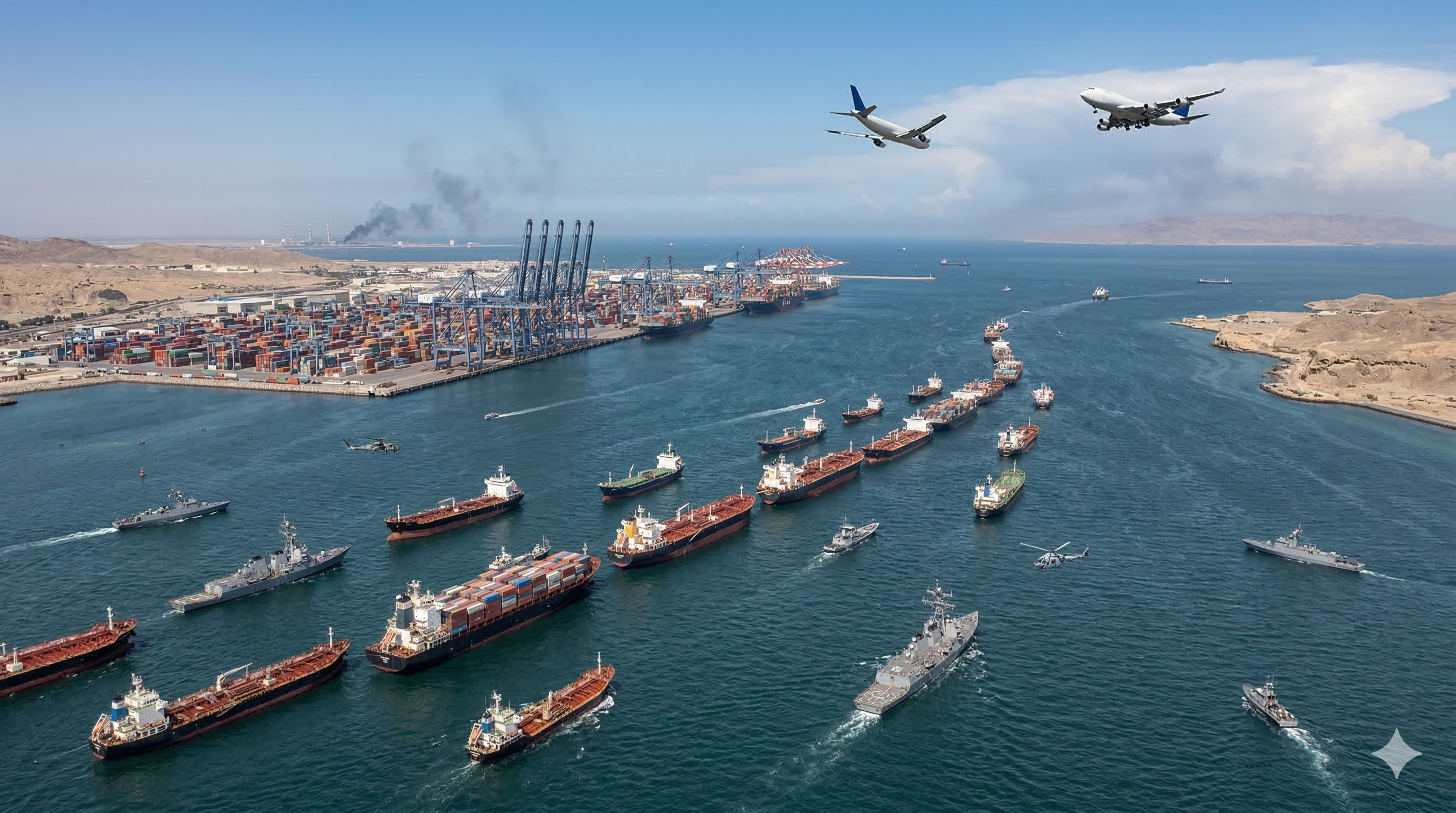
A security-driven disruption around the Strait of Hormuz is constraining commercial vessel transits and Gulf air networks. Carrier notices show widening booking suspensions into Upper Gulf markets, while advisories report airspace closures and operational constraints that are extending transit times and raising cost and liability uncertainty for Gulf-linked cargo.
- Carrier directives are driving a de facto shutdown of Gulf-linked routings even where no single, uniform legal closure exists.
- Maersk and others have suspended new bookings to multiple Upper Gulf markets, tightening acceptance rules and creating cutoff volatility.
- Airspace restrictions and hub risk are reducing air cargo lift and pushing longer routings and schedule uncertainty.
- Even partial reopening could still leave weeks of backlog, equipment imbalance, and irregular flight rotations.
A rapidly escalating security situation around the Strait of Hormuz has pushed ocean carriers and logistics providers to suspend new bookings into parts of the Gulf, while airspace restrictions and episodic port constraints are compounding delays for time- and schedule-critical cargo.
The disruption is not yet a single, clean “closure” in the legal sense across all jurisdictions, but it is functioning as a major operational shutdown: risk conditions, warnings, insurer posture, and carrier directives have sharply reduced commercial transits and constrained cargo acceptance into several Gulf markets. A growing set of advisories and carrier notices indicate that the situation remains fluid and could tighten further with little notice.
What happened and when
- Late February into early March 2026: The crisis intensified following the outbreak of open conflict involving Iran and U.S.-aligned forces, with commercial traffic in and around the Gulf increasingly avoiding transit due to security risk.
- March 2–4, 2026: Multiple logistics advisories reported airspace closures across several Gulf countries and widespread service suspensions/diversions for both ocean and air freight. For example, an International Maritime Organization (IMO) statement referenced a deadly attack on a vessel in the Strait of Hormuz on March 6 with multiple fatalities—an indicator that the threat environment has shifted from “elevated risk” to direct casualty events. (IMO statement)
- March 11–16, 2026: Reporting indicated the U.S. administration was seeking ways to reopen the passage and discussed naval escorts, while acknowledging uncertainty over duration and escalation risk. (AP on reopening challenges, Axios on escorts, AP live updates)
What carriers and forwarders are doing
Ocean: suspensions, “no new bookings,” and diversion-by-policy
Carrier customer notices show a shift from selective restrictions (e.g., certain commodities) to broader booking suspensions into key Gulf markets.
- A.P. Moller–Maersk issued a customer notice dated March 4, 2026, stating that “due to the escalation of security risks … and the effective closure of the Strait of Hormuz,” it would suspend new bookings between worldwide origins and multiple Upper Gulf markets (including UAE, Qatar, parts of Saudi Arabia, Bahrain, Kuwait, Iraq and Oman) and apply the suspension to cargo “originating from, destined for, or transhipping through” the listed countries. (Maersk customer notice PDF)
- A separate regional advisory distributed by shipping-risk intelligence sources dated March 3, 2026 noted that while there had been “no internationally recognised legal closure,” company-level directives and military warnings had already driven a sharp reduction in commercial traffic, with most vessels avoiding transit. (ISS Shipping Middle East Port Advisory PDF)
Operationally, this matters because the Gulf’s hub ports—particularly the UAE’s major terminals—serve both local demand and wider transshipment patterns. Even when terminals remain open, carrier acceptance is tightening and schedules are being reworked, creating uncertainty around cutoffs, container availability, and onward connections.
Air freight: airspace closures and hub disruption
Several logistics advisories describe a simultaneous shock to air networks:
- The March 3 regional advisory reported airspace closed in most Gulf countries, triggering large-scale rerouting and delays. (ISS Shipping Middle East Port Advisory PDF)
- A March 2–4 wave of forwarder updates described suspended or rerouted services and reduced operations at key hubs until further notice due to restricted airspace. (DSV advisory)
- AP reporting on March 16 said an Iranian drone attack set a fuel tank ablaze at Dubai International Airport, underscoring that aviation disruption risk is not only airspace-related but also tied to physical threats at critical nodes. (AP live updates)
For shippers, the practical effect is reduced lift, longer routings, less predictable transit times, and greater exposure to embargo-style acceptance rules (battery restrictions, dangerous goods, oversize/outsized cargo) depending on the carrier and routing.
Why this matters for industrial supply chains
The Strait of Hormuz is a core chokepoint for energy and petrochemical flows as well as containerized and project cargo moving in and out of Gulf markets. Beyond the immediate Gulf impact, the event has three broader logistics consequences:
- Energy-price pressure feeding transport costs. AP reporting linked rising gasoline prices to the crisis and noted the complexity of safely restoring passage in narrow shipping lanes under threat. (AP on reopening challenges)
- Diversion and substitution costs. When direct sea and air links compress, cargo tends to shift to alternative routings—overland trucking corridors, feeder workarounds, indirect air via less-affected airports—often with higher cost and heavier documentation burdens.
- Insurance, liability, and force majeure mechanics. Carrier booking halts and war-risk decisions can change who is responsible for storage, demurrage/detention exposure, and reroute costs—particularly for cargo already at origin terminals or already afloat.
What remains uncertain
- Duration and enforceability: Advisories emphasize that the disruption may be de facto rather than uniformly de jure, and that conditions can change daily depending on military developments and carrier risk assessments. (ISS Shipping Middle East Port Advisory PDF)
- Scope of carrier restrictions: Some notices focus on “new bookings,” while others may restrict specific cargo types (reefer, hazardous, out-of-gauge) or specific lanes. Shippers should expect frequent amendments.
- Operational recovery sequencing: Even if limited transits restart under escort, the backlog of anchored vessels, equipment imbalances, and disrupted flight rotations can extend lead times for weeks.
Near-term operational implications to watch
- Booking acceptance and cutoff volatility for Gulf destinations and transshipment routings via Gulf hubs.
- Air cargo capacity shrinkage on lanes that typically rely on Gulf hub connectivity (Asia–Europe, Africa–Asia, and some Europe–South Asia routings).
- Higher war-risk and security-related surcharges, plus possible changes to cargo insurance terms for certain routings.
- Customs and inspection slowdowns in affected markets where staffing, systems, or airport/port access are disrupted.
What this means for CAP Logistics readers
For CAP Logistics customers moving industrial cargo—especially time-sensitive spares, project equipment, chemicals, and energy-adjacent freight—the practical next step is to validate carrier acceptance rules and routing options shipment-by-shipment (including insurance and “already in transit” liability), and to plan for longer buffers on Gulf-linked routings until transit conditions and airspace restrictions stabilize.
FAQ
Is the Strait of Hormuz officially closed?
Some advisories state there has been no universally recognized legal closure across all jurisdictions, but carrier directives and security conditions have sharply reduced commercial transits, creating a de facto operational closure for many services.
What does a carrier “booking suspension” mean in practice?
It typically means the carrier will not accept new freight for the listed destinations (and sometimes for transshipment via those markets). Cargo already moving may be held, diverted, or subject to revised routings and surcharges depending on the bill of lading terms and the carrier’s notice.
How is air cargo affected if the disruption is maritime?
Airspace restrictions, security measures, and hub disruption in the Gulf can reduce available lift and force rerouting, which lengthens transit times and increases costs—especially on lanes that normally connect through Gulf hub airports.