

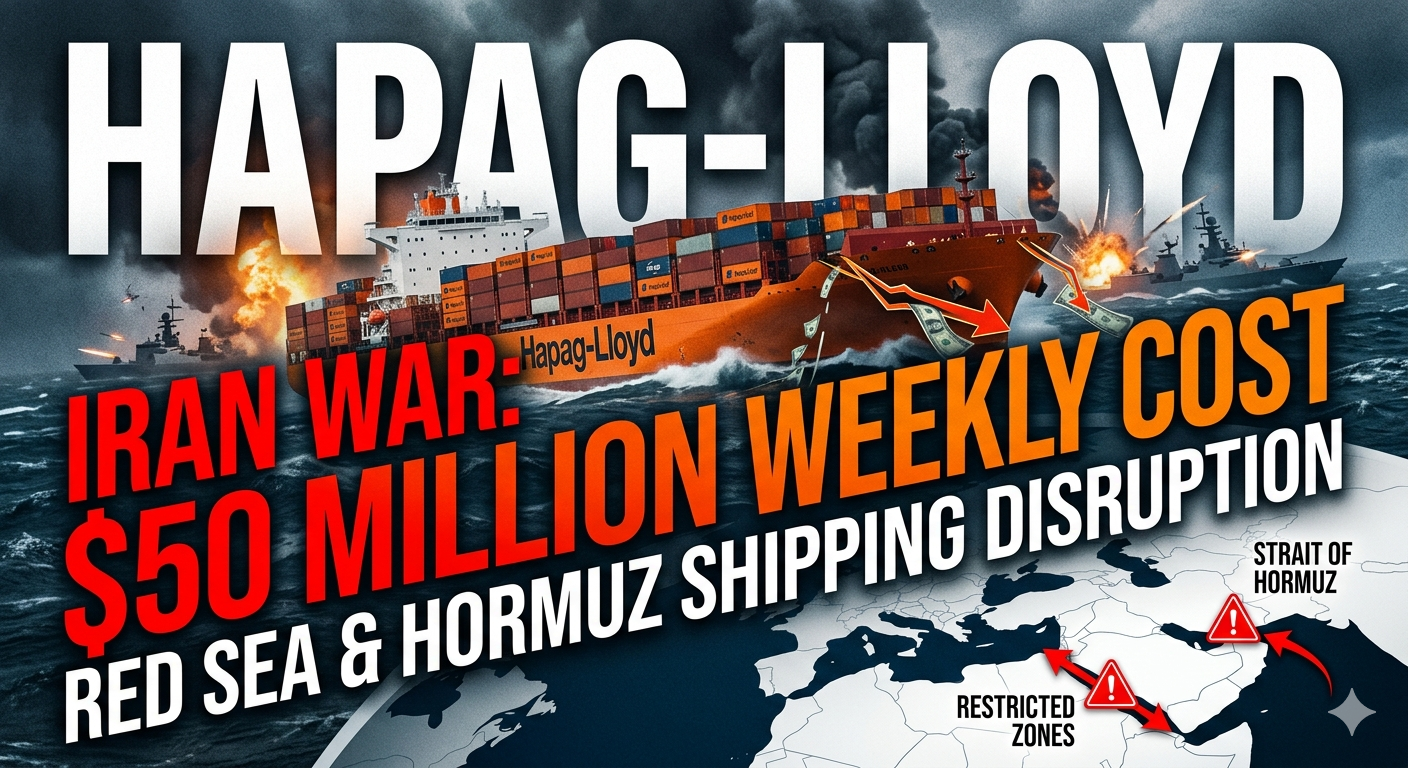
Hapag-Lloyd’s latest results and management comments show the Iran conflict is imposing major weekly costs on container shipping while extending disruption across the Red Sea and Strait of Hormuz. The development matters beyond one carrier because it raises voyage costs, prolongs diversions, tightens equipment and schedule reliability, and is already feeding into other parts of the transport market.
- Hapag-Lloyd says the Iran war is costing it $40 million to $50 million per week in added shipping expenses.
- The carrier’s 2025 earnings fell sharply even as transport volume rose 8% to 13.5 million TEU.
- Traffic through the Strait of Hormuz has dropped sharply, while major carriers have suspended or restricted Gulf transits.
- Red Sea normalization now looks less likely in the near term, extending Cape of Good Hope diversions.
- Higher energy and transport costs are already spilling into adjacent markets, including U.S. parcel pricing.
Hapag-Lloyd said the war involving Iran is now costing the carrier $40 million to $50 million per week in added fuel, insurance and related expenses, underscoring how a regional security crisis has become a material cost and routing problem for global container shipping. The warning came as the German liner operator reported sharply lower 2025 earnings despite carrying more cargo, with management pointing to a market still shaped by reroutings, network disruption and geopolitical risk.
What happened
In its preliminary 2025 results, Hapag-Lloyd said transport volume rose 8% to 13.5 million TEU, but the average freight rate fell 8% to $1,376 per TEU, pushing group EBITDA down to $3.6 billion and EBIT to $1.1 billion. The company had already signaled that higher operating costs and continued network disruption were weighing on performance.
That pressure has intensified in March 2026. Reporting around Hapag-Lloyd management’s latest comments indicates the Iran war is now costing the company roughly $40 million-$50 million per week, mainly from longer routings, higher bunker consumption, war-risk costs and other disruption-related expenses. Industry reporting also indicates the carrier has had to suspend Gulf transits and impose war-risk charges on affected cargoes as the security situation around the Strait of Hormuz and the Red Sea deteriorated.
Why this matters beyond one carrier
This is bigger than a single earnings story. Hapag-Lloyd’s comments are a useful proxy for what happens when two of the world’s most important maritime chokepoints are effectively impaired at the same time.
The Strait of Hormuz is a critical artery for global energy and regional trade. As the conflict escalated in March, commercial traffic through the strait fell sharply. An AP report citing Lloyd’s List Intelligence said only about 150 vessels had transited since March 1, 2026. A separate Reuters report carried by Yahoo Finance said only 77 ships had crossed the strait by mid-March, with mainstream tanker traffic especially constrained.
At the same time, hopes for a broader return of container lines to the Suez/Red Sea corridor have receded. Lloyd’s List reported that leading container carriers halted Hormuz transits and again moved away from Suez routings after the conflict escalated, extending the industry’s reliance on longer voyages around the Cape of Good Hope.
For carriers, that means more than fuel. Longer diversions consume vessel capacity, disrupt equipment positioning, complicate schedule integrity, and increase insurance and security costs. For cargo owners, the effects show up as less reliable transit times, higher surcharges, rolling booking restrictions and more volatile lead-time planning.
The route and cost mechanics
Hapag-Lloyd had already been dealing with the aftereffects of prolonged Red Sea disruption. In its prior half-year reporting, the company said earnings were pressured by start-up costs for the Gemini network, congestion and inflation, while rerouting and disruption continued to affect operating conditions. The latest phase of the Iran conflict adds a second layer of stress.
Industry advisories published in early March show how quickly carriers tightened operations in the Gulf. A maritime operations advisory from the Emirates Shipping Association said major container lines including Hapag-Lloyd, Maersk, MSC, CMA CGM and COSCO suspended transits through the Strait of Hormuz, while emergency surcharges and booking restrictions spread across Gulf trades. The same advisory said Hapag-Lloyd introduced a war-risk surcharge of $1,500 per TEU, with higher charges for reefers and special cargo.
A separate disruption update from the Global Cold Chain Alliance said Hapag-Lloyd suspended vessel transits through Hormuz, imposed booking stops for several Gulf destinations, and temporarily suspended certain services while evaluating revised port rotations and multimodal alternatives.
Those workarounds matter because Gulf cargo does not simply disappear when direct sailings stop. It often shifts into more complicated combinations of feedering, land bridge moves, alternate gateway use and deferred sailings. That raises handoff risk and can be especially problematic for project cargo, critical spares, reefer freight and any shipment tied to fixed outage or commissioning windows.
The energy angle is amplifying logistics risk
The shipping disruption is unfolding alongside a sharp energy shock. AP reported that Brent crude climbed above $100 per barrel after the conflict escalated from March 1, and subsequent coverage showed prices remaining volatile as markets reacted to risks around production and transit. That matters operationally because fuel inflation does not stay confined to ocean freight. It tends to filter into parcel, trucking, air cargo and rail fuel-related pricing.
One early sign came from the U.S. parcel market. The U.S. Postal Service said on March 25, 2026 that it is seeking a temporary 8% surcharge on products including Priority Mail, Priority Mail Express, USPS Ground Advantage and Parcel Select, citing transportation cost pressure and saying the change would run from April 26, 2026, to January 17, 2027, pending approval.
What remains uncertain
Several key variables are still unsettled.
1. Duration of restricted Gulf transits
It remains unclear whether carriers will reopen normal Gulf loops soon, or whether they will continue operating through selective booking controls and multimodal substitutes. The answer depends less on formal declarations than on day-to-day security assessments, insurer appetite and naval risk guidance.
2. Whether Red Sea returns are pushed further out
Before the latest escalation, parts of the liner industry had been looking for a broader normalization of Suez routings in 2026. That now looks less likely in the near term. If Red Sea avoidance persists while Gulf restrictions continue, the market may stay tighter than many shippers had expected for the year.
3. How far costs cascade inland
Ocean carriers can impose war-risk and contingency charges relatively quickly. Inland transport providers and parcel carriers respond on different timelines, but the USPS filing shows the pass-through has already started in at least one part of the U.S. logistics system.
Operational implications for industrial supply chains
For industrial and heavy-industry supply chains, the practical issue is not only higher rates. It is the increased probability of timing failure.
Longer sailing distances around Africa consume capacity that would otherwise help stabilize schedules. Booking controls into Gulf destinations can force cargo into alternate routings with more transfers. Energy-price volatility raises the risk of fresh fuel adjustments across transport modes. And project-critical freight tied to plant turnarounds, construction mobilizations or mining and power equipment schedules becomes harder to protect when the network is absorbing both maritime insecurity and cost inflation at once.
The immediate takeaway is that March 2026 is no longer just another chapter in the Red Sea disruption story. With Hormuz traffic constrained and carriers quantifying weekly financial damage, the market is dealing with a broader Middle East shipping shock that reaches from vessel deployment and insurance to parcel pricing and industrial lead times.
For CAP Logistics readers, the near-term value is in tighter shipment prioritization, earlier routing decisions and closer review of cargo moving through, into or indirectly dependent on Middle East and Suez-linked networks. This is especially relevant for project cargo, critical replacement parts and any move where schedule slippage creates plant or construction downtime risk.